

Play 2048 Online Free: The Complete Guide
Play 2048 free no download needed ↗
You opened this page for one reason. You want to play 2048 online, free, right now, without downloading anything. Good news — you can do exactly that here. But this page is more than just a play button. It's the deepest guide on 2048 you'll find anywhere, covering rules, strategy, history and every question you might have along the way.
What Is 2048?
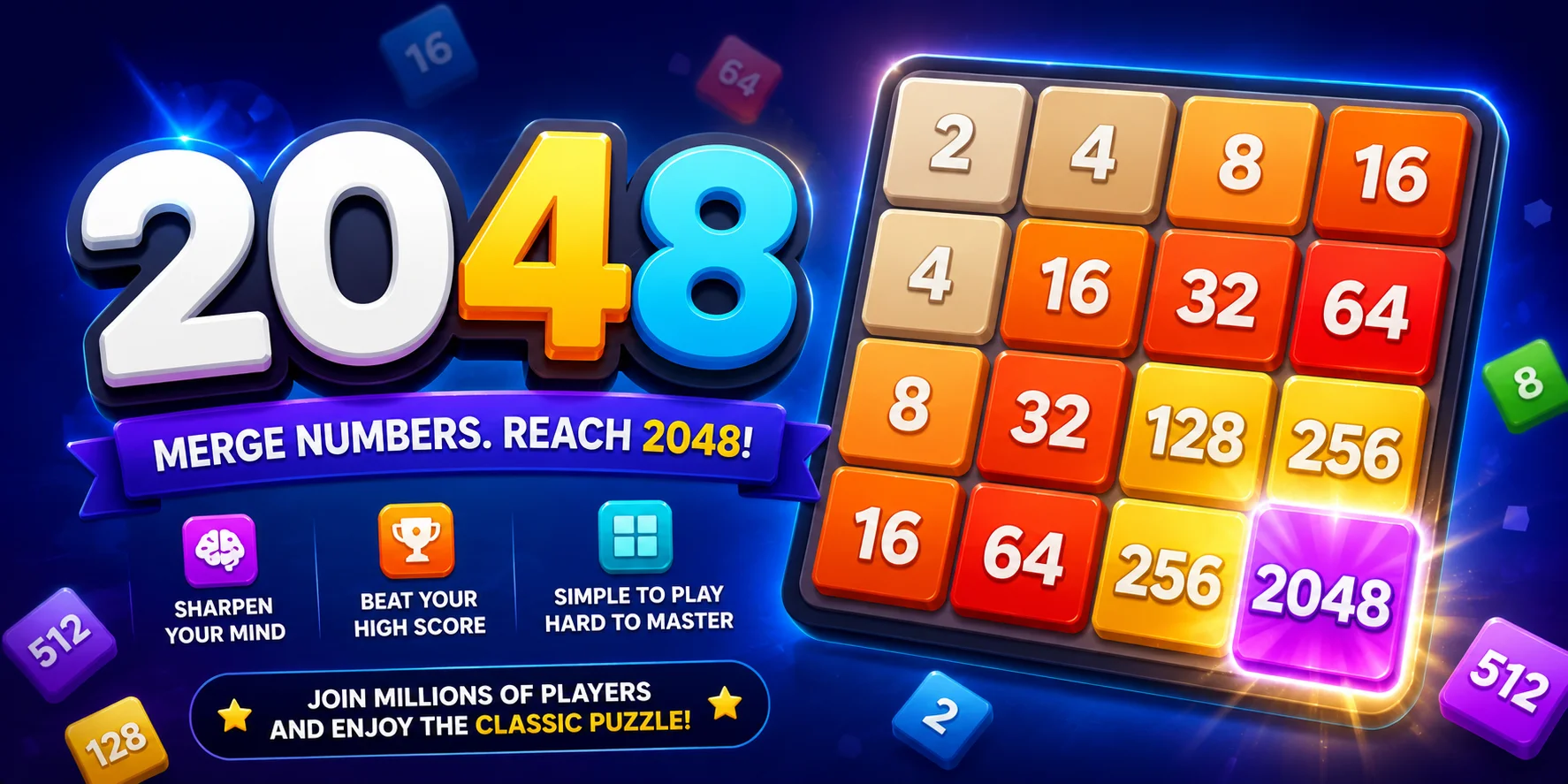
2048 is a number puzzle game. You slide tiles on a small grid. Matching numbers merge into one. The goal is simple — keep merging until you build the tile worth 2048. It sounds easy. It is easy to learn. But mastering it takes real thought. A teenage developer named Gabriele Cirulli built 2048 in 2014.
He made it in one weekend. He never expected it to explode the way it did. Within days, millions of people were playing it. Schools blocked it. Offices blocked it. People played anyway, hiding their screens during meetings. The game was inspired by an earlier game called 1024, which itself borrowed ideas from a game called Threes.
Cirulli simplified the formula and released his version as open source. That single decision changed everything. Because the code was free and open, anyone could copy it, tweak it and rebuild it. That's why today you'll find hundreds of 2048 spin-offs — 3D versions, hexagon boards, Doge themed tiles and even a multiplayer mode where you race a friend to win.
How to Control 2048 on Any Device?
Controls feel different depending on what you're playing on. Getting them right from the first move saves you frustration later.
On a computer, everything runs through your arrow keys. There's no mouse clicking involved once the game starts.
On a phone or tablet, you swipe instead of pressing keys. The direction of your swipe is the direction every tile slides.
| Device | Move Up | Move Down | Move Left | Move Right |
|---|---|---|---|---|
| Keyboard (PC/Laptop) | ↑ Arrow Key | ↓ Arrow Key | ← Arrow Key | → Arrow Key |
| Touchscreen (Phone/Tablet) | Swipe Up | Swipe Down | Swipe Left | Swipe Right |
| Alternate Keys (some versions) | W | S | A | D |
One small tip on touchscreens, short and deliberate swipes work better than fast flicks. Fast flicks sometimes register the wrong direction, costing you a move you didn't intend to make.
How to Play 2048: Rules Explained Simply
The board is a 4x4 grid. That's 16 squares total. You start with two tiles, each showing a 2 or a 4. You move tiles using your arrow keys. On a phone, you swipe instead. Every tile slides as far as it can in the direction you choose. When two tiles touch with the same number, they combine.
Two 2s become a 4. Two 4s become an 8. The pattern keeps doubling all the way up. Here's the part beginners miss every move adds a new tile to the board. The game punishes wasted moves. If you move without merging anything useful, you're filling space you'll need later. You win when you create the 2048 tile. But you don't have to stop there.
- Win condition: Build the 2048 tile.
- Game over condition: No empty cells remain, and no two adjacent tiles match.
- Bonus goal: Keep playing past 2048 to chase 4096, 8192 or higher.
Many players don't realize the game continues after the win screen. You can close that popup and keep merging for a much higher score.
The Math Behind the Magic
2048 isn't random nonsense dressed up as a game. It's built on real math specifically, powers of two. Every number on the board is two multiplied by itself a certain number of times. Two, four, eight, sixteen each step doubles the last. That's why the numbers always feel oddly satisfying when they line up.
This is also why 2048 works so well as a brain exercise. You're not just sliding tiles. You're doing rapid mental addition without realizing it. Teachers have used 2048 in classrooms to make doubling and place value feel less like homework.
Kids merge tiles and learn math patterns at the same time, without a worksheet in sight. If you've ever wondered why this simple game feels weirdly addictive, that's part of the answer. Your brain enjoys spotting patterns. 2048 hands you a fresh pattern puzzle every single move.
Winning Strategy: Beyond Beginner Tips
Most beginner guides stop at keep your big tile in a corner. That's true but it's only step one. Real strategy goes much deeper.
The Corner and Edge Method
Pick one corner of the board. Decide it will hold your largest tile, always. Every move you make should protect that corner. Once your biggest tile sits there, build a line of decreasing values along the edge next to it.
Think of it like a staircase, the biggest tile at the top step, smaller ones below. This method works because it stops your big tile from getting trapped or separated from tiles it needs to merge with later.
Monotonicity: The Secret Word Pros Use
Monotonicity sounds complicated. It just means keeping your numbers in one smooth order across a row or column, instead of scattered randomly. A board with monotonic order looks clean biggest number on one side, smallest on the other, no awkward jumps in between.
This kind of order makes merging predictable instead of lucky. Without monotonicity, you end up with two big tiles stuck far apart, unable to combine. That's usually how games end early.
Managing Empty Space
New tiles spawn after every move. If your board fills up fast, you're in trouble. Smart players deliberately avoid moves that don't create a merge, especially late in the game. Every unnecessary move is one less empty cell you have to work with. Think of empty space as a resource. Spend it wisely, not randomly.
When to Break Your Own Rules
Sometimes the board forces a tough choice. You might have to break your corner temporarily to avoid getting completely stuck. Good players treat this as a short term sacrifice. Break the rule for one move, then rebuild the pattern immediately after. This flexibility separates intermediate players from advanced ones. Rigid play loses. Adaptive play wins.
Why Play 2048 Online Instead of Downloading an App?
There's a strong case for skipping the app store entirely. Browser based play means zero storage used on your phone. No update notifications. No permissions to approve. You open a tab and you're playing within two seconds. It also means the game works the same everywhere.
Switch from your laptop at home to your phone on the bus and nothing changes. Your skills transfer instantly because the game never does. Many app versions add things you didn't ask for ads between rounds, in app purchases, account sign ups. Playing in the browser strips all of that away. It's just you and the grid.
2048 Variants Worth Knowing About
Because the original game is open source, creators around the world built their own spins on it. Here are a few worth understanding.
- 3D 2048: Played across a cube instead of a flat grid, adding a depth dimension to your strategy.
- Hexagonal 2048: Swaps the square grid for six-sided tiles, changing how merges line up.
- Multiplayer 2048: Two players race side by side toward the same goal in real time.
- Themed reskins: Same mechanics, different visuals animals, memes or emoji replace plain numbers.
- 144 Variant: A trickier version where only the number 1 spawns and your win target is 144 instead of 2048.
None of these change the core skill you're building. They just test it from a different angle.
Is 2048 Actually Good for Your Brain?
This question comes up constantly, and the honest answer is yes, with a small catch. The game sharpens short term planning. You're constantly thinking two or three moves ahead, which mirrors skills used in chess and other strategy games. It also builds pattern recognition.
Your brain starts predicting merges before they happen, almost on autopilot, after enough practice. The catch: 2048 isn't a substitute for deep learning or schoolwork. It's a light mental warm up, not a replacement for real study. Use it as a break, not a crutch.
Plenty of parents allow their kids to play specifically because it sneaks in math practice disguised as fun. That's a fair trade for screen time.
Accessibility and Playing on Any Device
A genuinely good 2048 experience should work no matter how you access it. Keyboard players need arrow keys to respond instantly, without lag or missed inputs. Touch users need swipe gestures that feel natural, not finicky. Screen size matters too.
A board that looks great on a desktop monitor needs to shrink cleanly onto a small phone screen without losing tap accuracy. If you're playing here, you can expect a smooth response on a laptop, tablet, or phone browser, with no installation step standing between you and your first move.
Common Mistakes That Cost You the Game
Even experienced players fall into a few repeated traps. Rushing moves without checking the whole board first is the biggest one. A two second pause before each swipe saves dozens of wasted turns later. Ignoring small tiles is another trap.
Players often chase the biggest number and forget that small 2s and 4s pile up fast clogging the board. Finally panicking near a full board leads to random swipes. Random swipes are almost always worse than one carefully planned move even if that move feels slow.
Conclusion
2048 looks simple at first glance but real skill hides underneath those sliding tiles. Learn the corner method, respect your empty space and stop rushing your moves. The grid rewards patience more than luck. Now that you know the rules and the strategy behind them, open the game above and put it to the test.
Frequently Asked Questions
Is 2048 free to play?
Yes. 2048 is completely free, with no purchase required to play or win.
Can I play 2048 without downloading anything?
Yes. The game runs fully in your browser, on any device, with no install needed.
How do you win 2048?
You win by merging tiles until you create one tile with the value 2048.
What is the best strategy for 2048?
Keep your highest tile in a corner and build the rest of the board in descending order around it.
Is 2048 hard to learn?
No. The rules take under a minute to learn, though mastering high scores takes practice.
Is 2048 good for the brain?
Yes, it builds planning and pattern recognition skills, similar to light strategy games.
Can I keep playing after reaching 2048?
Yes. Closing the win screen lets you continue toward 4096, 8192, and beyond.
Who created the 2048 game?
Gabriele Cirulli, an Italian developer, created 2048 in 2014 and released it as open source.