
More like this
 Exclusive Works on phone ArrowGo 3D
  New Bloxorz
  Works on phone Cool Math Games
  Exclusive Works on phone Hexa Puzzle 3D
  Works on phone 2048
  Candy Crush
  Works on phone Cut the Rope
  Exclusive Works on phone Spin Stack 3D
  Exclusive Works on phone Wood Screw 3D
  Achievement Unlocked
  Breaking the Bank
  Exclusive Works on phone Bubble Shooting 3D
 Sliding Puzzle Game: Free Online, No Download Needed
Your brain loves a good puzzle. There's something deeply satisfying about watching scattered tiles snap into a perfect picture one careful slide at a time. That's exactly why the sliding puzzle game has survived for over a century jumping from wooden toys to your phone screen without losing an ounce of its charm. In this guide you'll learn how to play why this game works offline with zero wifi, the surprising math behind solvable puzzles and the strategies that separate lucky guessers from real solvers.
Sliding Puzzle was made by Talha Bin Yousaf. It is open source under the MIT license. Source code on GitHub.
What Is a Sliding Puzzle Game?
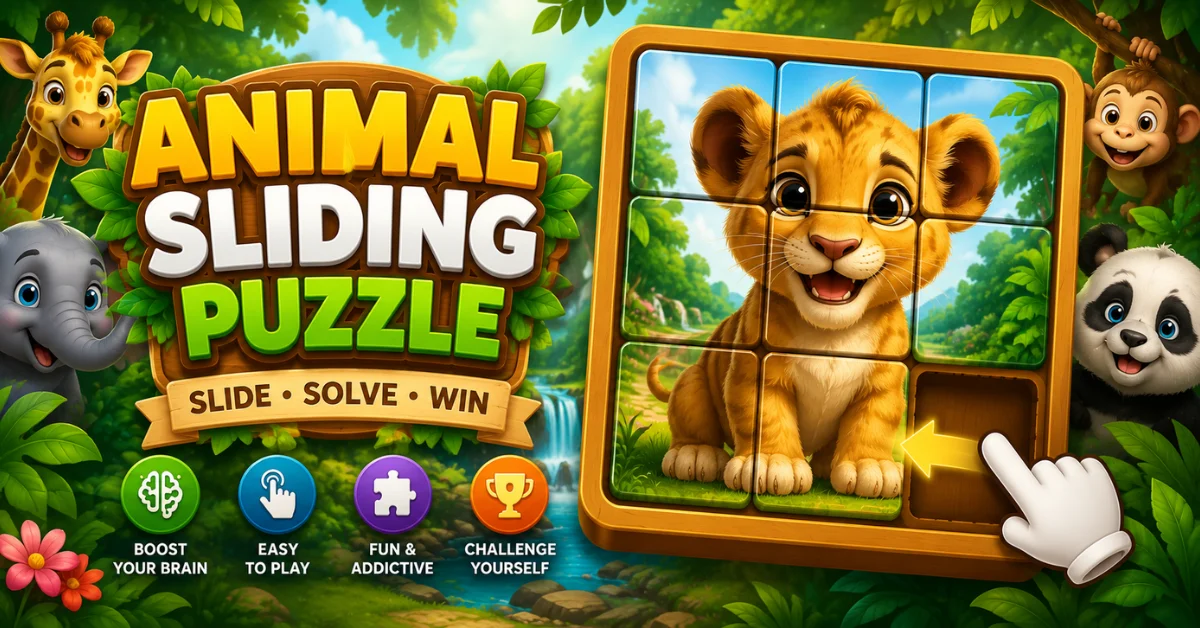
A sliding puzzle game is a tile based logic game built around one empty space. Every tile next to that gap can slide into it. Nothing lifts, nothing floats every move happens through that single open slot. The goal is simple. Arrange numbered tiles in order or rebuild a scrambled picture, using only that one empty square. It sounds easy. It rarely plays that way.
How to Play Sliding Puzzle Games Online
Playing online strips away all the setup. There's no box of loose tiles to lose, no torn corners, no waiting. You open the browser and the puzzle is already scrambled and ready. The core rules never change no matter the platform:
- Only tiles touching the empty space can move.
- One tile slides per move, straight up, down, left or right.
- The puzzle is solved when numbers sit in order or the image is whole again.
- You can restart instantly if a round feels stuck.
Controls for Every Device
On the desktop you simply click the tile you want to move. On mobile, a tap or a quick swipe does the same job. Either way the puzzle responds instantly so you never lose your train of thought waiting on lag.
Why Offline Sliding Puzzle Games Are Changing the Way We Play
Here's something most gaming sites never mention you don't need wifi to enjoy a sliding puzzle. Once the page loads the entire game lives in your browser's memory. No signal, no problem. This matters more than people realize. Flights, subway rides, spotty rural signals even a dead router at home none of it stops you. A true offline browser game keeps working exactly like an installed app, minus the download and the storage headache.
That's the whole idea behind a Progressive Web App. The game catches itself quietly the first time you play. After that it behaves like it's already on your device ready the moment you open it again. No login screen and no app store detour required.
Quick Game Snapshot
Before you jump in here's what you're getting. Genre: logic and brain puzzle. The platform works on PC, mobile and tablet browsers alike. Technology built with lightweight HTML5 so nothing needs installing. Controls click, tap or swipe. Offline status fully playable without an internet connection once loaded.
The History Behind the Classic 15 Puzzle
The sliding puzzle isn't a modern invention dressed up in new graphics. It dates back to the 1880s when a 4x4 grid called the 15 Puzzle swept across America and Europe like a fever. Puzzle maker Sam Loyd is often credited with popularizing it though the true inventor's identity was murky even then. Loyd famously offered a $1,000 prize to anyone who could solve a version with two tiles swapped.
Nobody ever claimed that prize. The reason is beautifully simple math, not bad luck. Swapping two tiles changes something called parity and that single change makes the puzzle mathematically impossible to solve no matter how skilled the player is. That story has quietly followed the sliding puzzle game for 140 years. It's a rare case where a puzzle's history is just as interesting as playing it.
Sliding Puzzle Strategy: Tips to Solve Faster
Random clicking might get you lucky on a small 3x3 board. On anything bigger you need an actual method or you'll shuffle the same tiles back and forth forever.
Beginner Techniques
Start small and build structure early. These habits turn a confusing board into a manageable one:
- Solve the top row first left to right.
- Lock the left column next without disturbing the row above it.
- Treat the empty space as your tool not an obstacle.
- Avoid chasing one tile directly plan its full path instead.
Advanced Rotation Patterns
Once the top row and left column are locked you're left with a smaller puzzle inside the bigger one. This is where most players get stuck because the final block needs a rotation trick instead of straight line moves. Learn the 2x3 rotation pattern for the last few tiles. It looks fiddly the first time but it becomes automatic after a handful of tries. This single skill is the real difference between finishing a hard puzzle and abandoning it halfway.
Is Every Sliding Puzzle Solvable? The Math Behind It
Not every scrambled arrangement can be solved and that isn't a glitch. It comes down to a mathematical property called parity, the same idea behind Sam Loyd's unclaimed prize. Think of it this way. Every tile swap flips a hidden switch. If that switch lands in the wrong position after shuffling no sequence of legal moves can ever fix it.
Good online sliding puzzle games solve this quietly in the background generating boards only from legal moves so every puzzle you see is guaranteed solvable. That's a small detail but it matters. It means your frustration on a hard level is always earned never the result of a broken board.
Sliding Puzzle vs Jigsaw Puzzle: What's the Difference
Both puzzles ask you to rebuild an image but the similarities stop there. A jigsaw puzzle lets you lift any piece and place it anywhere. There's no constraint beyond finding the right shape. A sliding puzzle removes that freedom completely. Every tile is trapped in a grid and only the empty space lets anything move at all.
That single restriction is what turns a picture puzzle into a genuine logic challenge closer to chess than to a jigsaw box. If jigsaw puzzles reward patience, sliding puzzles reward planning. You're not searching for pieces. You're managing space.
Different Grid Sizes and Difficulty Levels
Grid size changes everything about how a sliding puzzle feels. A 3x3 board known as the Game of 8 is forgiving enough for a first try with room to recover from mistakes. Step up to 4x4 the true 15 Puzzle and the difficulty jumps sharply. Larger boards like 5x5 or 6x6 aren't just harder versions of the same game.
Every added row multiplies the number of possible states meaning the empty space has to travel much farther to fix even one tile. Picture based puzzles add a second layer of difficulty on top of grid size. Numbers show you exactly where a tile belongs. Images make you hunt for landmarks, edges and color patterns first.
Common Mistakes to Avoid
Most players lose progress the same few ways. Recognizing these habits early saves a lot of wasted moves.
- Moving tiles randomly instead of following a row by row plan.
- Disturbing a solved row while chasing a later tile.
- Rushing the final block before setting up rotation space.
- Ignoring where the empty space needs to go next.
Conclusion
The sliding puzzle game has outlasted trends for one simple reason it respects your intelligence. Behind that one empty square sits real math, real history and a genuine test of planning. Play it online, skip the download, skip the wifi worries and let the tiles remind you why this classic never really left. Whether you're chasing a fast solve or just a few calm minutes offline the puzzle is always exactly as fair as your next move.
Frequently Asked Questions
What is a sliding puzzle game?
A sliding puzzle game is a logic puzzle where tiles move only through one empty space, until numbers or an image are fully arranged.
Can I play sliding puzzle games without downloading anything?
Yes. Browser based sliding puzzles run instantly online with no download, no install and no signup required.
Do sliding puzzle games work without wifi?
Yes. Once the page loads, offline ready sliding puzzles keep working with no internet connection needed.
Is every sliding puzzle solvable?
Not every random arrangement is solvable but quality online puzzles generate boards using only legal moves so every level can be finished.
What is the fastest way to solve a sliding puzzle?
Solve the top row first, lock the left column next, then use rotation patterns to finish the final tiles without disturbing earlier progress.